Homemade Cleaning Supplies That Save Real Money (7 Recipes That Work)
This article may contain affiliate links. If you make a purchase through these links, we may earn a small commission at no extra cost to you. Learn more
Quick Answer
Homemade Cleaning Supplies That Save Real Money (7 Recipes That Work)
Four basic ingredients replace 90 percent of commercial cleaners: white vinegar, baking soda, Dawn dish soap, and hydrogen peroxide. Combined in different ratios, they clean glass, floors, countertops, bathrooms, and laundry for pennies per use vs 5-8 dollars per bottle. Make in small batches as needed — no storage issues.
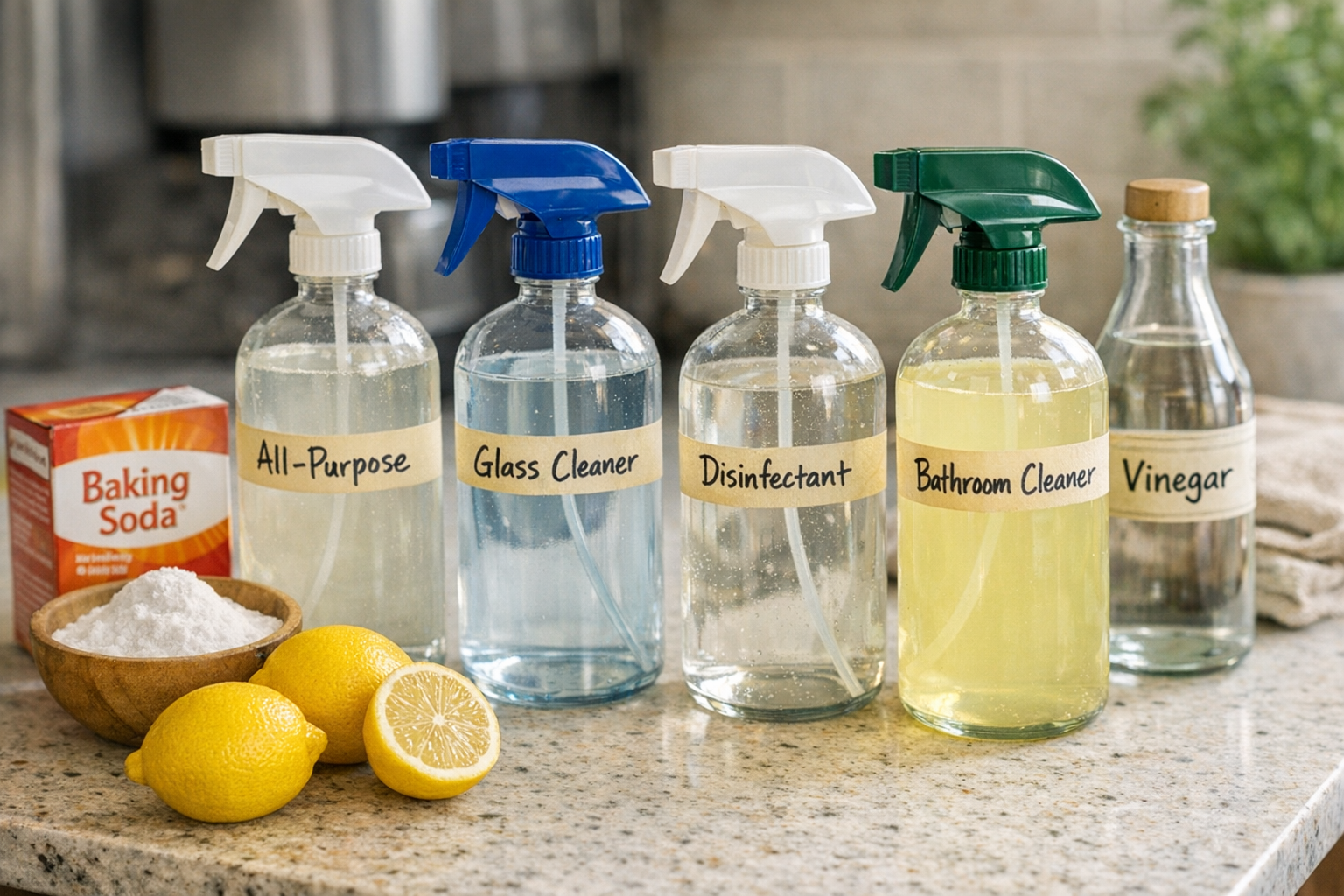
A family of 4 spends 300 to 500 dollars a year on cleaning supplies. The honest math: most of that money goes to fancy packaging and marketing. The actual cleaning ingredients are the same 4 cheap items from any grocery store.
Here are the 7 recipes that replace almost everything in the cleaning aisle. Each costs pennies per batch vs 5 to 8 dollars for the name-brand equivalent.
The 4 Ingredients You Need
- White vinegar — acid, cuts grease and soap scum, kills mold and some bacteria
- Baking soda — mild abrasive, neutralizes odors, lifts grime
- Dawn dish soap — surfactant, breaks down oils
- 3 percent hydrogen peroxide — disinfects, lightens stains
Total cost for a year's supply: under 25 dollars.
You'll also need a few empty spray bottles — glass lasts longer than plastic, or reuse empty store-bought cleaner bottles.
Recipe 1: All-Purpose Cleaner
Replaces: Windex Multi-Surface, Formula 409, Mr. Clean ($4-6/bottle)
- 1 cup water
- 1 cup white vinegar
- 1 tablespoon Dawn dish soap
- (Optional: a few drops of lemon essential oil for smell)
Mix in a spray bottle. Use on countertops, appliances, outside of cabinets, tables. Not safe for natural stone (granite, marble) — vinegar etches stone.
Cost per batch: around 25 cents. Commercial: 4-6 dollars.
Recipe 2: Glass and Mirror Cleaner
Replaces: Windex ($5-7/bottle)
- 2 cups water
- 1/4 cup white vinegar
- 1 tablespoon cornstarch (the secret — leaves no streaks)
- (Optional: 1 tablespoon rubbing alcohol for faster evaporation in humid climates)
Shake well before each use (cornstarch settles). Spray and wipe with a clean microfiber cloth.
Cost per batch: 15 cents. Commercial: 5-7 dollars.
Recipe 3: Bathroom Tub and Tile Scrub
Replaces: Soft Scrub, Comet, Bar Keepers Friend ($3-5/container)
- 1/2 cup baking soda
- Dawn dish soap (enough to make a paste)
Mix in a bowl to a thick paste. Apply to tub, tiles, grout. Let sit 10 minutes. Scrub with a non-scratch sponge. Rinse.
For tougher soap scum, add a few drops of vinegar to the paste right before applying.
Cost per batch: 20 cents. Commercial: 3-5 dollars.
Recipe 4: Toilet Bowl Cleaner
Replaces: Lysol Toilet Bowl Cleaner ($4-6/bottle)
- 1/2 cup baking soda
- 1 cup white vinegar
Pour baking soda into the bowl. Follow with vinegar — it'll fizz. Let sit 10 minutes. Scrub with a toilet brush. Flush.
For hard water stains under the rim, add a cup of citric acid and let sit overnight.
Cost per use: 10 cents. Commercial: 3-5 dollars.
Recipe 5: Floor Cleaner
Replaces: Pine-Sol, Mr. Clean, Fabuloso ($4-6/bottle)
For hardwood, tile, and LVP floors:
- 1 gallon warm water
- 1/2 cup white vinegar
- 1 tablespoon Dawn dish soap
- (Optional: 10 drops lemon or lavender essential oil)
Mop as usual. Don't use on waxed floors — vinegar strips wax.
For sealed hardwood, skip the Dawn entirely — just a tablespoon of vinegar in a gallon of water.
Cost per batch: 25 cents. Commercial: 5-7 dollars.
Recipe 6: Disinfecting Spray
Replaces: Lysol Disinfectant, Clorox Spray ($5-8/bottle)
- 1 cup water
- 1 cup 3 percent hydrogen peroxide
- (Optional: 10 drops tea tree or eucalyptus essential oil)
Use on doorknobs, light switches, phone, remote controls, and high-touch surfaces. Spray, leave 3 minutes, wipe dry.
Important: Don't mix vinegar and hydrogen peroxide in the same bottle — they form peracetic acid, which is irritating to skin and eyes. Either vinegar OR hydrogen peroxide in a given recipe, not both.
Cost per batch: 50 cents. Commercial: 5-8 dollars.
Recipe 7: Laundry Stain Remover
Replaces: Shout, OxiClean spray ($4-6/bottle)
- 1 part Dawn dish soap
- 2 parts 3 percent hydrogen peroxide
- 1 part baking soda (optional, for tough stains)
Mix and apply directly to stains. Let sit 5 to 10 minutes before washing. Works on grass, grease, blood, red wine, coffee.
Test on a hidden spot first for delicate or colored fabrics — hydrogen peroxide can lighten some dyes.
Cost per batch: 30 cents. Commercial: 4-6 dollars.
What NOT to DIY
A few cleaning tasks are better with commercial products:
- Dishwasher detergent. DIY versions (vinegar, borax) work poorly vs modern enzymatic detergents. Use Cascade Platinum Plus pods.
- Laundry detergent. DIY laundry powder doesn't fully rinse out and builds up in fabrics. Buy commercial.
- Grease/oven degreaser. Caked-on oven grease is chemical work. DIY baking soda paste helps but commercial oven cleaner is much faster for deep cleans.
Common DIY Cleaner Mistakes
- Mixing bleach with ANY of these ingredients — dangerous gas. Never mix bleach with vinegar, hydrogen peroxide, or ammonia (in some dish soaps).
- Using vinegar on stone. Etches marble, granite, travertine. Stick to stone-safe commercial cleaners for those surfaces.
- Making huge batches. Some combinations lose potency fast (vinegar+water OK for weeks; DIY disinfectant loses effectiveness within days). Make in weekly-size batches.
- Skipping the test spot. Test any new recipe on a hidden area of the surface first.
Storage
- Make batches in reusable spray bottles and label with a Sharpie or chalkboard labels
- Store in a cool dark place
- Vinegar-based cleaners last months; hydrogen peroxide-based cleaners, 1 to 2 weeks max
The Annual Savings
A typical family spends about 400 dollars a year on cleaning supplies. Switching to these DIY recipes (plus keeping a few specialty commercial products) drops annual spending to around 80 to 100 dollars. Net savings: roughly 300 dollars a year.
Frequently Asked Questions
Are DIY cleaners as effective as commercial cleaners?
For most household cleaning tasks, yes — the active ingredients are similar or identical. Commercial cleaners have better fragrance and packaging, not better cleaning chemistry. For specialty tasks (oven degreasing, dishwasher detergent), commercial still wins.
Are DIY cleaners safe for pets and kids?
Generally safer than commercial cleaners — no synthetic fragrances, no parabens, no petroleum byproducts. But: vinegar in large amounts irritates pets' noses, essential oils (tea tree, eucalyptus) are toxic to cats. Keep any spray bottle out of reach of kids.
Can I use apple cider vinegar instead of white vinegar?
Yes, but apple cider vinegar is more expensive and has a stronger smell. White distilled vinegar is the standard for cleaning — cheaper and odor dissipates faster.
How long do homemade cleaners last?
Varies by recipe:
- Vinegar + water: 3 months+
- All-purpose with Dawn: 1 to 2 months
- Hydrogen peroxide-based: 1 to 2 weeks (peroxide breaks down in light)
- Disinfecting spray: 1 week max
Make in small batches as needed.
Final Thoughts
The cleaning aisle is 95 percent marketing. Four basic ingredients handle the vast majority of household cleaning for a fraction of the cost. Buy a set of labeled glass spray bottles, mix recipes as you need them, and you'll never walk down the cleaning aisle the same way again.
Get weekly home tips that actually work
Join thousands of homeowners getting practical cleaning hacks, DIY fixes, and money-saving tips every week. Free, and you can unsubscribe anytime.

Written by
Priya PatelKitchen & Lifestyle Writer
Priya Patel is a former restaurant pastry chef turned home-cooking obsessive. She writes about meal prep, kitchen organization, and the small appliances actually worth your counter space. Priya tests recipes and gadgets out of a tiny Brooklyn galley kitchen, so she has strong opinions about what earns its footprint.
Recommended Products
Looking for specific product recommendations? Check out our tested picks.

Best Outdoor Patio Furniture Deals (2026 Spring Picks)
Late April is the sweet spot for patio furniture deals — pre-summer sales without late-season picked-over selection. Here are the picks worth buying now.
5 Best LED Light Bulbs to Cut Your Electric Bill (2026)
Switch to LED bulbs and save $100+ per year on electricity. We compared the top LED bulbs for brightness, color quality, and longevity — here are the 5 best picks.
Best Smart Thermostats to Lower Your Energy Bill (2026)
The best smart thermostats that actually save money on heating and cooling. We compare 5 top picks from Nest, Ecobee, Honeywell, and more with real energy savings data.
Related Articles

DIY vs. Hiring a Pro: The Real ROI of 8 Popular Home Projects (2026)
A contractor breaks down the real DIY vs. pro cost, time, and resale ROI of 8 popular home projects in 2026, with a decision framework and tool picks.

Hurricane Season 2026: Survival Strategy Beyond Basic Emergency Kits
A complete hurricane season survival strategy for 2026: communication plans, insurance gaps, financial recovery, and power backup that go far beyond the basic emergency kit.

Summer Outdoor Living 2026: Patio, Grill, Garden & Decor Buying Guide
A complete 2026 summer outdoor living buying guide covering patio furniture, grills, lighting, plants, and decor, with real prices and the best week to buy each.
Memorial Day Cookout Prep: Food, Decor & Timing for 30 Guests
Host a patriotic Memorial Day cookout for 30 guests under $200. Bulk shopping math, make-ahead strategies, and an hour-by-hour timeline to skip day-of stress.